Stayton Parks and Pool Levy (Measure 24-518)
May 19, 2026 Election

  • What is the Parks and Pool Levy?
    The Parks and Pool Levy (Measure 24-518), will continue to fund parks and pool operations in the City of Stayton for five years, beginning in fiscal year 2026-2027. 
     
    The levy rate is $0.985 per $1,000 of Assessed Value (AV).
     
    The Parks and Pool Levy replaces the existing $0.50 per $1,000 of AV levy that expires on June 30, 2026. The five year operating levy will enable maintaining current levels of service and operations for the City’s 11 parks and natural areas as well as the Stayton Family Memorial Pool.

    What does the Levy fund? 
    If passed, the Parks and Pool Levy will contribute ~$1 million annually starting on June 30, 2026 towards the City’s parks and pool operations, supporting:

    - Stayton Family Memorial Pool operations.
    - Parks operations.
    - Park facilities, including restrooms.
    - Repairs on park amenities such as swing seats, picnic tables, and playground equipment.

    If the Levy doesn’t pass, the City will face an annual funding gap of ~$1 million and Stayton City Council will have to make budget reductions. It is most likely that the pool will close and park operations and amenities will be reduced to align with available resources.

    To download the Stayton Parks and Pool Levy fact sheet, please click here

Press the enter key or spacebar to expand or collapse the accordion

  • Please see below for Frequently Asked Questions (FAQs) about the Parks and Pool Levy (Measure 24-518) To download a copy of the FAQs, please click here


    The purpose of these FAQs is to provide transparent, neutral information to help Stayton residents make an informed decision when voting on the May 2026 Parks and Pool Levy.

    If there is a question not listed here, please submit your question to:  CityGovernment@staytonoregon.gov and we will attempt to answer it in future versions.
    • A local option levy assesses property with an additional tax, therefore all property owners are assessed.  This includes owners of multi-family residential, commercial and industrial in addition to single family homes.  How that cost is transferred to tenants is up to the owner, however the costs are borne by owners of real estate.

      The table below shows the total AV (Assessed Value) per acre by land use type.  This shows that multifamily contributes a little bit more per acre than single family to the tax base per acre.  Commercial and Industrial land contributes a little less per acre than single family.

    Press the enter key or spacebar to expand or collapse the accordion

    • The existing levy will expire on June 30, 2026. Based on current financial projections, the parks and pool programs combined would face an estimated annual funding gap of approximately $1 million each year.

      Without a replacement funding source, the City would need to reduce services to align with available resources. This would include closure of the pool, which would likely be permanent, as the costs and infrastructure impacts associated with shutting down and later reopening the facility are significant.

      Park maintenance would be reduced to essential health and safety needs. Some park facilities, such as restrooms, would likely close, and routine repairs to amenities such as swing seats, picnic tables, and playground equipment would be deferred. Amenities that become damaged and cannot be repaired may be removed or decommissioned to address safety concerns.

      If funding is not secured, the City would also need to evaluate reducing the number of parks and facilities it maintains in order to manage long-term maintenance obligations.

    Press the enter key or spacebar to expand or collapse the accordion

    • A local Option Levy authorizes an additional tax to be assessed on real property.  This is paid by property owners with their property taxes.  It is important to understand that real property is assessed based on a value derived from Measure 50, which was adopted in 1997.  Under Measure 50, a property’s assessed value (AV) was initially set at approximately 90% of its market value at the time and then limited to annual increases of no more than 3 percent, regardless of changes in market value. Property taxes are calculated using the lower assessed value, not the higher real market value (RMV).

      On a property tax statement, both values are shown. In many cases, the assessed value is significantly lower than the real market value. Assessed value does not reset when a property is sold. Adjustments may occur if previously unassessed improvements are identified, but assessed value is not based on the purchase price of a home.

      The figure below shows how the AV and RMV have diverged over time.


    Press the enter key or spacebar to expand or collapse the accordion

    • As discussed under Question 3 above, assessed value is derived by taking the value of properties in 1997, and reduced by 10%.  This became the baseline assessed value. Increases to the assessed value are limited to 3% per year, regardless of what the actual property value changes are.  Generally, the assessed value is about 50% of the real market value today.  The visual to the left helps to illustrate how the assessed value differs from the real market value of several single-family homes:

    Press the enter key or spacebar to expand or collapse the accordion

    • Several factors contributed to the higher proposed rate. Previous levies were structured to support operations but did not adequately fund overhead or reserves for the long-term replacement of aging equipment, amenities, and facilities. Over time, these assets require increased maintenance and eventual replacement, similar to the upkeep needs of an older home.

      In addition, the cost of labor, supplies and materials have increased more than levy revenues. The City is also maintaining more park acreage, and higher park use results in additional operational needs such as trash collection and restroom cleaning.

      Finally, while the City has experienced some growth, increases in assessed value and property tax revenue have not kept pace with the rising costs associated with operations, maintenance, and capital replacement. The proposed levy rate reflects these combined factors.

    Press the enter key or spacebar to expand or collapse the accordion

    • The levy proposed in November 2025 was $1.10 per $1,000 of assessed value. After that measure did not pass, the City conducted additional outreach, including stakeholder discussions and a community survey, and undertook further financial analysis.

      As a result of that work, the City removed Wilderness Park from levy funding, which accounted for approximately $0.02 per $1,000 of assessed value. The City also identified additional user fee increases at the pool.

      Finally, some staffing costs previously assumed to be funded through the levy have been reallocated and delayed. These adjustments are not expected to result in an overall reduction in service levels.

      Together, these changes reduced the proposed levy rate by $0.115, resulting in a revised rate of $0.985 per $1,000 of assessed value.

    Press the enter key or spacebar to expand or collapse the accordion

    • If passed, the levy will assess a local option tax of $.985 on each $1000 of Assessed Value for all property in Stayton. This is assed for all property including commercial, industrial, multi-family and single family residential.  The average AV for a single family home in Stayton is $252,000. The diagram below illustrates what that might look like for a variety of home values.

    Press the enter key or spacebar to expand or collapse the accordion

    • The total General Fund revenue is estimated to be $11,611,298 in the biennial (two year) budget.  This is made up of revenues from taxes, charges for service, fees, etc.  The General Fund pays for all city services that are not enterprise funds (water, wastewater, stormwater and streets).
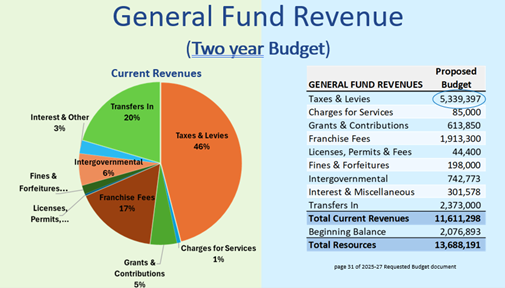


      The General Fund provides 100% of Police funding as well as funding for Municipal Court, Administration, Street lights, Community and Economic Development, Council, Community Center.  The General fund also provides subsidies to the Street Fund, the Library Fund, the Parks Fund and the Pool Fund.  
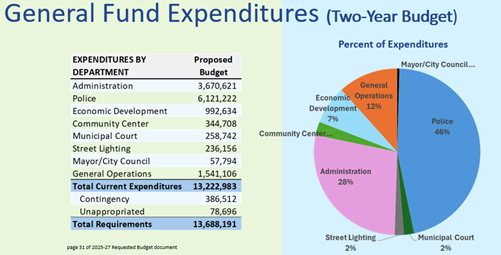


      If there were no levy, the General Fund would have to make up approximately $1 million per year to maintain the existing service levels at the parks and the pool.  This would require significant reductions from the other General Fund areas.
       

    Press the enter key or spacebar to expand or collapse the accordion

    • Public pools generally operate at a loss and therefore are subsidized in some form to maintain user fees that are acceptable to patrons and competitive in the market.  If prices are increased too high, usage of the pool will decline.  Staff carefully consider the cost of our pool compared to the cost for nearby pools to ensure our costs are competitive without being a barrier to overall usage.

      That said, we did look at the existing revenues and have found several areas where we believe revenues can be increased and still be competitive which resulted in a decrease in the amount determined to be needed through the levy.

      The charts below show the revenue sources for the pool and how the charges for service revenues are broken out.

    Press the enter key or spacebar to expand or collapse the accordion

    • The 2025-27 budget for the pool identifies $1,350,817 in expenditures and the Parks budget identifies $3,150,001 (including capital projects that are primarily funded by grants).  Both budgets assume a new operating levy is passed prior July 1, 2026.  The chart below shows how the funds are budgeted to be spent; excluding capital expenditures as that would skew the chart.  


    Press the enter key or spacebar to expand or collapse the accordion

    Press the enter key or spacebar to expand or collapse the accordion

Press the enter key or spacebar to expand or collapse the accordion

  • To request a presentation from the City Manager about the Stayton Pool & Parks Levy, please contact us via email at citygovernment@staytonoregon.gov

Press the enter key or spacebar to expand or collapse the accordion

  • If there is a question not listed here, please submit your question below and we will attempt to answer it in future versions of the FAQ.
    Email:required
    Parks and Pool Levy Questionrequired

Press the enter key or spacebar to expand or collapse the accordion